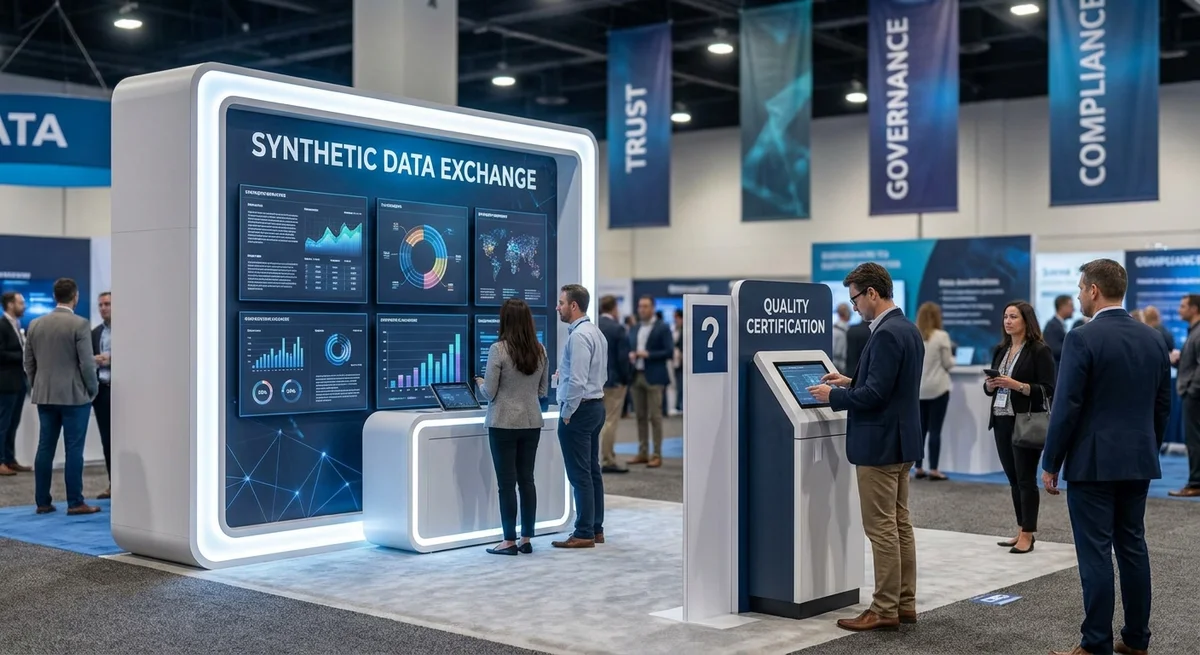
Synthetic Data Marketplaces: Trust, Quality, and Certification Gaps
Synthetic Data Marketplaces: Trust, Quality, and Certification Gaps
The synthetic data market is booming but still immature, and many buyers remain wary. Firms are investing heavily – one analysis projects the global synthetic data market to grow from a few hundred million dollars in 2024 to well over $1 billion by 2025 (quickmarketpitch.com) – buoyed by demand for AI training and privacy-safe data. Synthetic datasets, which “mimic real-world data while breaking direct links to sensitive information” (innodata.com), promise dramatic cost reduction and privacy benefits. They are increasingly used in AI model training, advanced analytics, and testing across industries (particularly healthcare, finance, and automotive) (quickmarketpitch.com). Yet alongside this growth, buyers often distrust synthetic data: they worry about data quality (will models trained on it be accurate?), representativeness (are rare cases or subpopulations captured?), and legal safety (could it still violate privacy or IP laws?).
Real-world experience highlights these gaps. Independent evaluations find that synthetic data often fails to capture complex patterns. For example, a Strat7 study of two synthetic tools on marketing survey data found that while basic statistics (like average brand awareness) matched real data, “boosted responses lacked the logical consistency of real people” when subjected to deeper analysis (www.research-live.com). Segmentation and regression outcomes diverged from the true data, producing artifacts like “bunching” at mid-range values (www.research-live.com). In fact, the researchers recommended limiting synthetic augmentation to around 5% of any sample to avoid misguiding analysis (www.research-live.com). Similarly, a healthcare study reported that 92% of predictive models trained on synthetic patient data performed worse than those trained on the real data (pmc.ncbi.nlm.nih.gov) – a small but real “accuracy decrease” that must be managed (pmc.ncbi.nlm.nih.gov). In short, synthetic data can accelerate projects when real data is scarce, but it usually “falls short” of fully replicating the utility of authentic data.
Buyers also fear synthetic data may introduce or fail to address bias and representativeness. For instance, a vendor claims its synthetic datasets “can be inflated to any size while allegedly correcting for biases” (journals.sagepub.com), but such promises are controversial. Without careful design, synthetic generators may either amplify existing biases or overlook minority cases. The lack of outliers and irregularities in some synthetic sets can further distort modeling (critics note synthetic samples often omit the “needle in the haystack” exceptions that observers study for trust (journals.sagepub.com)). In short, customers worry: Does the synthetic data really cover the same demographics, edge-cases, and context as the original? Until standard measures exist, those concerns persist.
Finally, legal and privacy safety are major unknowns. Many assume synthetic data automatically sidesteps privacy laws, but experts caution otherwise. An Iowa Law Review analysis notes that it is mistaken to claim synthetic data isn’t “personal data” (ilr.law.uiowa.edu). Even if records aren’t direct copies of real people, mathematical correlations or “inferences” drawn from them could still implicate privacy rules (ilr.law.uiowa.edu). Regulators and boards have yet to issue clear guidance: synthetic data can “put existing data governance on steroids,” challenging assumptions about what constitutes protected data (ilr.law.uiowa.edu). Beyond privacy, intellectual property is unclear – for example, if a synthetic text generator was trained on copyrighted books, who owns the outputs?
In sum, buyers lack confidence because synthetic data today is a bit of a “black box”. Are there tools to test and certify it? Is the provider trustworthy? Does the dataset indeed do what it claims? Many enterprises simply hold back or use synthetic data only for low-stakes scenarios due to these trust gaps.
Building a Trust Framework for Synthetic Data
To close these gaps, a security and trust layer is needed atop any synthetic data marketplace. This layer would provide transparent benchmarks, scores, and certifications so buyers know the data meets their needs. Key components include:
-
Benchmark Suites: Standard benchmarks should test synthetic data generators on real-world tasks. For example, NIST’s SDNist is a public benchmark with tabular datasets and metrics to evaluate fidelity (catalog.data.gov). A marketplace could adopt or develop similar open benchmarks (including time-series, images, or NLP tasks) so each dataset or generator is scored on objective utility metrics. The benchmarks could cover distribution matching, model performance, and more. By requiring generator tools to compete on these benchmarks, providers prove their synthetic data quality.
-
Bias and Fairness Scoring: Algorithms would audit datasets for representativeness and group fairness. Scores could flag if a dataset under-represents certain demographic slices or exhibits known biases. For instance, a synthetic health dataset might be checked to ensure gender or racial proportions don’t stray wildly from reality. This audit could draw on fairness metrics from ML research (equal predictive performance across groups) and enforce corrective steps. Each dataset would carry metadata on its bias metrics, helping buyers gauge if it’s fit for their application.
-
Privacy Risk Metrics: Just as we audit bias, we should score privacy safety. Privacy researchers note that simple similarity metrics don’t capture disclosure risk (papers.cool). Modern privacy frameworks recommend measuring membership inference risk (can an attacker tell if a real individual was in the original data?) or attribute disclosure. The marketplace could require synthetic data providers to run standardized privacy tests (e.g. measuring how likely it is to re-identify individuals or leak personal attributes) and report scores. In effect, offerings might carry a “privacy coin” rating: how safe is this data under common attacks? A gold standard would be formal differential privacy guarantees, but at minimum all datasets should be annotated with the techniques used and their empirical privacy scores (papers.cool) (doaj.org).
-
Lineage and Provenance Tracking: Buyers need to know where data came from. Every synthetic dataset should record its lineage: what source data it was based on, which generative model created it, and what processing steps were applied. Tools like blockchain audit trails can help. The startup Synthik, for example, uses Filecoin’s blockchain to log full provenance of data and models with cryptographic proofs (www.synthik.io) (www.synthik.io). By embedding an immutable record (hashes, timestamps, signatures) into each dataset, buyers can verify that no tampering occurred and exactly which algorithm and parameters were used in generation. This greatly increases trust: one can cryptographically confirm, for instance, that “dataset v2” legitimately descends from “dataset v1” with only the claimed changes.
-
Third-Party Certification: The marketplace should encourage (or require) independent audits. Analogous to the way DevOps pipelines have compliance checks, synthetic datasets could be “stamped” by trusted auditors. The public registry of CertifiedData is one model: each certified dataset entry has an Ed25519-signed certificate and a SHA-256 fingerprint, proving its identity and immutability (certifieddata.io). A broader certification framework (like The AI Lab’s AI Trust Registry) could audit data for governance, fairness, and documentation (theailab.org). Once certified, a dataset or generator would earn a visible seal of trust, signaling to buyers that it passed an independent review. Regulators and enterprises would then have a reference point when evaluating synthetic data, reducing uncertainty.
In practice, a marketplace’s “trust layer” could present each dataset with attached metadata: benchmark scores on fidelity, bias-disparity metrics, privacy-leakage ratings, full chain-of-custody, and certification badges. Buyers could filter offerings based on these attributes (e.g. “all datasets with ≥80% fidelity score and HIPAA compliance”), and verify claims via embedded cryptographic checks.
Marketplace Mechanics for Synthetic Data
Beyond trust signals, the marketplace architecture itself must reinforce quality and safety. Key design elements include:
-
Contributor Verification and Community Curation: Not every seller should be anonymous. At signup, synthetic data providers should undergo KYC-like verification (company registration checks, expert vetting) and agree to platform standards. Verified status (and perhaps reputation ratings) would be awarded to trustworthy contributors. As Glyx (a generic dataset marketplace) notes, it “onboards sellers via a rigorous verification process to ensure high-quality standards,” and “all sellers are verified and datasets are scanned for quality and compliance” (glyx.cloud). A synthetic marketplace should similarly validate vendors (for example, checking that a healthcare data seller has relevant credentials) and allow the community to flag poor datasets.
-
Dataset Versioning: Data evolves, so version control is crucial. Each dataset listing should support immutable version history (like Git for data). For example, if a provider updates a synthetic dataset (“v1.2 to v1.3”), the platform logs the old version’s fingerprint and links it to the new one. Buyers can then reproduce experiments or audits against a specific version. Coupling version hashes with the lineage system ensures transparency: every change or augmentation is traceable. Automated difference reports could even highlight how a version changed (new features added or distribution adjusted) to inform buyers.
-
Domain-Specific Categories (Verticalization): Different industries have unique needs. The marketplace should organize by vertical – e.g. Healthcare, Finance, Retail, Cybersecurity – and within each enforce relevant standards. For healthcare, synthetic EHR datasets must mimic patient records realistically while complying with HIPAA. Providers like DataXID highlight that their synthetic healthcare data “maintains the statistical integrity of real medical datasets while eliminating privacy risks” (dataxid.com). Thus a healthcare section might require proof of HIPAA training, ethical review, or use of medically valid templates. For finance, data like transaction logs or loan applications must reflect realistic customer profiles and fraud signals under regulations like GDPR or PCI-DSS. DataXID’s finance focus touts “privacy-preserving synthetic data” that meets “highest … compliance standards” (www.dataxid.com). In practice, verticals allow specialized benchmarks (e.g. credit scoring metrics for finance, diagnosis prediction for healthcare) and compliance checks.
By providing structured domains, the marketplace helps buyers find datasets tailored to their sector while holding providers to domain-specific quality. It also facilitates package deals: e.g. a healthcare suite might include linked tables of patient demographics, labs, and treatment records, all certified together.
Monetization and Governance
To sustain the marketplace, transparent fee structures and legal frameworks are needed:
-
Listing Fees and Commission (Take Rate): Many data marketplaces use a combination of fees. A common model is a small listing or subscription fee plus a percentage commission on each sale. For example, a platform might charge something like $50 to list a new dataset (to discourage spam) and take 10–30% of any purchase price. Tiered commissions can incentivize larger deals: one scheme has sellers keep 70–95% of revenue based on deal size (docs.opendatabay.com). (In one example, selling a dataset for £2,500 returned 80% to the seller (docs.opendatabay.com).) Some platforms even offer premium subscriptions: e.g. Japan’s JDEX data exchange has a paid tier with flat annual fee and reduced % fees (www.service.jdex.jp). A synthetic data marketplace could similarly blend subscription or listing charges with per-transaction take rates appropriate for its audience. The rules should be clear from the start: fixed fees for listing or supporting services (certification, marketing), and a transparent commission on successful transactions.
-
Intellectual Property (IP) Governance: Terms of service must clarify IP ownership of synthetic data. Typically, the creator of a synthetic dataset (the tool or person who generated it) would own the output, but liabilities can arise if the generative model violated someone else’s rights. The marketplace should require sellers to warrant that they have lawful rights to any real data used in training their synthetics and that the outputs do not infringe copyrights or trademarks. For instance, if a synthetic image generator was trained on copyrighted photos, the seller must either have a license or guarantee the output is original. Listings should disclose the training data source and any licenses. Legally, contracts often split IP: the platform and buyers need clarity on who can reuse or relicense the dataset. Aligning with common GenAI contract practices, marketplace agreements should specify that the seller retains IP to the synthetic data but grants the buyer a license to use it according to agreed terms.
-
Indemnification and Liability: Crucially, providers should indemnify buyers against legal claims arising from the synthetic data. Just as software suppliers now often shoulder IP infringement risks for their outputs (www.jdsupra.com), synthetic data vendors may need to protect their customers. If a dataset is later challenged for privacy breach or IP theft, the seller (or marketplace) may have to cover damages. Given the novelty of the field, indemnity clauses are becoming standard in GenAI agreements (www.jdsupra.com). Buyers should demand warranties that synthetic records do not contain hidden PII or protected content. Sellers offering indemnity signals confidence in their data pipeline. At minimum, the platform should require sellers to hold the necessary data licenses and to indemnify buyers for third-party claims. Over time, we expect more robust “output indemnities” in line with AI industry trends (www.jdsupra.com).
-
Regulatory Compliance: For regulated sectors, governance may extend to audit readiness. A marketplace might provide legal templates or insure transactions. For example, synthetic healthcare data offerings could include a Data Use Agreement attesting HIPAA compliance. The platform might also maintain an internal compliance office that reviews high-risk datasets (the “Sentinel” or “Guardian” levels in trusted AI registries) before approval.
By combining listing/transaction fees with strong legal terms, the marketplace ensures sustainability and risk management. Commission revenue sustains operations and trust infrastructure (certification, audits), while legal bonds (warranties, indemnities) protect users.
Conclusion
Synthetic data marketplaces have enormous potential to unlock powerful AI and analytics by easing data sharing and preserving privacy. Yet that potential will materialize only if buyers trust the data. Today’s gaps – uncertainty about quality, fairness, and legality – can be closed with a robust oversight layer and marketplace design. Benchmarking and scoring systems will give objective measures of fidelity, bias, and privacy, while provenance tracking and independent certification will guarantee authenticity. Rigorous contributor vetting, clear version control, and industry vertical sections will ensure data is fit for purpose in sensitive domains like healthcare or finance. Finally, transparent monetization (fair fees and revenue-sharing) and strong governance around IP and indemnity will align incentives and manage risk.
In practice, an entrepreneur building a synthetic data marketplace would do well to integrate these features from day one. For example, requiring new datasets to upload a provenance file (as Synthik does (www.synthik.io)),assigning them a scorecard from NIST-like benchmarks (catalog.data.gov), and optionally submitting them for audit (as CertifiedData does with tamper-proof certificates (certifieddata.io)) would quickly set the platform apart. Healthcare customers would see datasets labeled with HIPAA compliance and realistic patient diversity (dataxid.com); finance teams could filter for data with GDPR-safe fields and fraud-pattern coverage (www.dataxid.com). All the while, the marketplace would sustain itself by modest listing fees and a commission on each sale (docs.opendatabay.com), reinvesting that in governance, customer support, and legal frameworks.
By combining these elements, synthetic data marketplaces can mature from niche experiments into trusted exchanges. Entrepreneurs should seize this moment to bake transparency, accountability, and rigor into their platforms. Doing so will not only protect customers and rights-holders, but will also accelerate adoption – building confidence that synthetic data is not just a convenient shortcut, but a reliable, certified resource verified by experts.
See what AI users want before you build
Get Founder Insights on AI Agent Store — real visitor demand signals, early adopter goals, and conversion analytics to help you validate ideas and prioritize features faster.
Get Founder InsightsGet new founder research before everyone else
Subscribe for new articles and podcast episodes on market gaps, product opportunities, demand signals, and what founders should build next.